• Home
  • Archives
  • About Tom
  • Privacy Policy
  • Contact Us
  • Sitemap

Tropical Boating

Stories about Boats and Boating

  • Sailing
    • Races & Regattas
    • Sailboat Cruising
    • Sailboat Reviews
  • Powerboating
  • Kayaking
  • Fishing
  • Boat Handling
  • Repairs & Upgrades
  • Equipment & Gear
    • Dinghies
  • Boat Building
  • Boating Fun
  • Boating Safety
  • General
    • Trail Camera Pictures
You are here: Home / Boat Handling / Small Outboard Engine Tilt and Trim: Theory and Practice

Small Outboard Engine Tilt and Trim: Theory and Practice

December 31, 2007 By Tom Leave a Comment

This entry is part 1 of 3 in the series Tilt & Trim
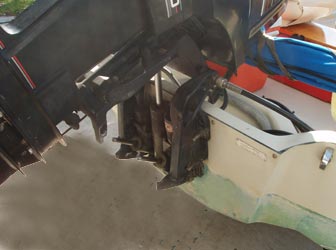
The hydraulic tilt and trim on my Boston Whaler's Merc 70My first 15' Boston Whaler, back when I was a teenager, had only manual tilt, and I longed for a hydraulic tilt and trim engine. My current 15' Boston Whaler has a Merc 70 with hydraulic tilt and trim (pictured above), which makes it far easier to adjust the engine's attitude for different situations.


This one is for the manual tilt small engine folks:

Most outboard engines 30 hp and below do not have power tilt and trim. They usually have 5 holes into which a pin can be inserted, varying the angle of the engine relative to the transom of the boat. They also have a bracket that can be flipped down to prop the engine up at around a 45 degree angle for operating in shallow water at slow speeds. A small outboard in shallow water drive can operate in as little as 6 inches of water.

So how do you decide which of the 5 tilt positions is best for your boat? And once the best one is identified, is there any use for the other 4?

The second question is the easiest to answer: Yes, there are uses. The wrong tilt position can be loads of fun.

The answer to the first question will depend on the angle of the transom or bracket on which the engine is mounted. When the boat is on plane in smooth water, it should be trimmed properly in a slightly bow-up attitude, and the propeller shaft should be nearly parallel with the surface of the water.

Tilted too high

If the engine is tilted too high, the bow of the boat will ride too high, and the stern will "squat" in the water. Many boats will start porpoising in this condition. The tilt of the engine lifts the bow too high, the bow falls down, it gets lifted too high again, and so on. Simply tilting the engine in to the next hole down should correct the problem.

There is some use for an engine tilted too high, other than the one linked above. When riding with large following seas, burying the bow of the boat in the next wave is a serious concern. I have done it, and it is not fun. To avoid it, tilt the engine higher than you ordinarily would, and run the boat just barely on plane. The bow will stay safely above the waves (most of the time).

If the engine is not tilted high enough, it will push the bow of the boat too far down, making it plow along. For cruising in smooth water, it is slow and inefficient, and the engine should be tilted further out for proper trim.

Too little tilt

There is also a use for too little tilt. When powering into small chop, most boats will ride more comfortably if they are cutting through it with the sharp part of the hull up forward, rather than bouncing along on top, hitting the waves with the middle of the hull. Do not do this when powering into large waves, or you might drive right through the wave. This is even less fun than going through a wave in following seas.

Find the best tilt position for your boat

If your engine is mounted on a more or less vertical transom or bracket, you will probably find that the 2nd or 3rd tilt holes work best for most applications. Tilting in one position from the "best" one can help a heavily loaded boat to get on plane, and can yield a more comfortable ride in chop (though it can also be a more wet ride). Tilting out one position can provide a smoother, safer ride downwind in heavy waves, and can make for a more dry ride, as the hull will break through the water further aft.

Other than those special applications, most small engines are generally left in the "best" position all the time.

Tilt & Trim

Outboard Engine Tilt and Trim for Medium Size Outboards

Filed Under: Boat Handling, Powerboating Tagged With: small boats, outboard, tilt & trim

Leave a Reply Cancel reply

You must be logged in to post a comment.

Newer: Blown Down in a 44′ CSY
Older: The Time I Got Thrown Overboard

Recent Posts

  • BOTE Aero Rover Inflatable SUP MicroSkiffs!
  • ePropulsion Electric Outboard On A Picnic Cat
  • Com-Pac Picnic Cat Fun!
  • Selling the Stray Goat
  • June 2021 Stray Goat Projects

Topics

  • Boat Building (5)
  • Boat Handling (10)
  • Boat Repairs & Upgrades (50)
  • Boating Equipment (27)
    • Dinghies (4)
  • Boating Fun (30)
  • Boating Safety (7)
  • Buying & Selling Boats (5)
  • Classic Boating Tales (25)
  • Fishing (16)
  • General (37)
    • Drone Stuff (3)
    • Trail Camera Pictures (18)
    • Tropical Fruiting (1)
  • Kayaking (22)
  • Powerboating (18)
  • Sailing (71)
    • Races & Regattas (14)
    • Sailboat Cruising (15)
    • Sailboat Reviews (7)

Popular Posts

  • The Perfect Solo Mast-Raising System for Small Sailboats 132.9k views
  • Small Outboard Engine Tilt and Trim: Theory and Practice 57.8k views
  • How to Dock an Outboard or Sterndrive Powerboat in 3 Easy Pictures 57.3k views
  • Tying Boats to Docks Using Springlines 55.8k views
  • Deep V, Shallow V, or Variable Deadrise Hull Performance 52.3k views
  • The Com-Pac Sun Cat: A Review 46k views
  • Building a Live Bait Well For A Small Boat 40.3k views
  • Choosing the Right Propeller For Your Boat 36.5k views
  • Rebuilding Whaleboat Tenders Part 5: Boat Parts Shopping Day 36.3k views
  • More Boston Whaler Modifications 35.4k views

Recent

  • BOTE Aero Rover Inflatable SUP MicroSkiffs!
  • ePropulsion Electric Outboard On A Picnic Cat
  • Com-Pac Picnic Cat Fun!
  • Selling the Stray Goat
  • June 2021 Stray Goat Projects

About Tom

Starting with the little two-person inflatable raft I had as my very first boat, I have always loved the freedom and the feeling of being out on the water. With my father's help, I added a hard plywood floor to that little inflatable, and that was the beginning of a long chain of boats I have owned, loved, maintained, modified, fixed, enjoyed, and scared myself to death on over the past few decades. [Read More …]

Popular Posts

  • The Perfect Solo Mast-Raising System for Small Sailboats 132.9k views
  • Small Outboard Engine Tilt and Trim: Theory and Practice 57.8k views
  • How to Dock an Outboard or Sterndrive Powerboat in 3 Easy Pictures 57.3k views
  • Tying Boats to Docks Using Springlines 55.8k views
  • Deep V, Shallow V, or Variable Deadrise Hull Performance 52.3k views
  • The Com-Pac Sun Cat: A Review 46k views
  • Building a Live Bait Well For A Small Boat 40.3k views
  • Choosing the Right Propeller For Your Boat 36.5k views
  • Rebuilding Whaleboat Tenders Part 5: Boat Parts Shopping Day 36.3k views
  • More Boston Whaler Modifications 35.4k views

Topics

  • Boat Building (5)
  • Boat Handling (10)
  • Boat Repairs & Upgrades (50)
  • Boating Equipment (27)
    • Dinghies (4)
  • Boating Fun (30)
  • Boating Safety (7)
  • Buying & Selling Boats (5)
  • Classic Boating Tales (25)
  • Fishing (16)
  • General (37)
    • Drone Stuff (3)
    • Trail Camera Pictures (18)
    • Tropical Fruiting (1)
  • Kayaking (22)
  • Powerboating (18)
  • Sailing (71)
    • Races & Regattas (14)
    • Sailboat Cruising (15)
    • Sailboat Reviews (7)

Back to Top
Contact Us · Privacy Policy & Disclosure

Copyright © 2007-2026 · Tropical Boating
Site managed by Tropical Web Works